Jun 23, 2026
5 Min
What Would You Ask Your Assistant If It Actually Knew Your Business?
Most AI assistants know everything except your business. Here's what changes when the one you talk to actually has the answers already sitting inside your company.

The problem was never a lack of answers
Every business already has the answer to most of its own questions. The problem is never a lack of information; it's that the information is scattered across tools that don't talk to each other, so someone has to go find it every time.
Every business generates far more knowledge than any one person can hold in their head. Calls get logged. Deals get discussed. Decisions get made in a Slack thread that everyone forgets by Friday. None of it disappears. It just piles up somewhere you'd have to go looking for it.
This isn't a small drag on a workday either. Research from the McKinsey Global Institute has long pointed to how much of the workweek gets absorbed by exactly this kind of searching and gathering, time that never shows up as "work" but eats into it all the same. Multiply that by every person on a small team who's re-asking a question the business already answered once, and it adds up to something closer to a second job nobody signed up for.
It's not just the time spent looking, either. Every time you stop what you're doing to go dig up an answer, you're paying a second, hidden cost. Research from Gloria Mark at UC Irvine has found that it takes an average of over 23 minutes to fully refocus after an interruption. A question that takes two minutes to answer can cost twenty more once you factor in getting your head back into what you were doing before you went looking.
And the tool-hopping itself has a price tag. Intuit's own 2024 survey of small and midsize business owners found their teams spend an average of 25 hours a week on manual data entry and reconciling information across apps, the exact kind of scattered-answer problem that shows up every time someone has to piece together what the business already knows from four different places.
The usual fix is more tools. A better wiki. A pinned Slack channel. A shared doc someone swears they'll keep updated. Every one of these asks you to remember where you put the answer, which is the same problem with better branding.
What if you could just ask?
Ask lets you get a direct answer to a business question instead of searching for it yourself. Not search. Not scroll. Ask, the way you'd ask a colleague who happened to be in every meeting, read every email, and remembers every call.
That's the category Ask exists in. Not a search bar that returns ten links and hopes you pick the right one. A place you bring an actual question and get an actual answer, grounded in what your business has already said and done.
Imagine what that looks like day to day:
"What's our current policy on rush orders?" "What did the client say they needed by, on that call last Tuesday?" "Have we worked with this vendor before, and how did it go?"
None of these questions need a dashboard. They need someone, or something, that already knows.
A day of questions worth asking.
Here's what asking instead of searching actually looks like across one ordinary business day.
9:10am.
Your ops lead needs to know if a returning customer already has an open support ticket before calling them back. Instead of checking three tools, she asks Ask. The answer comes back with the ticket number and what was already promised.
12:40pm.
A salesperson is about to walk into a call and can't remember what the client pushed back on last time. He asks Ask. The objection from the last call is right there, in the client's own words.
3:15pm.
You're asked in a board update how many leads the spring campaign actually generated, not the vanity click number, the ones that turned into real conversations. You ask Ask instead of pulling three reports together. You have the number in the time it takes to type the question.
5:50pm.
Someone new on the team wants to know the actual policy on rush orders, the real one, not the one from the outdated PDF in the shared drive. They ask Ask, and get the version the business is actually using today.
None of these moments needed a meeting. None of them needed someone to remember where a file lives. They needed one question and one honest answer.
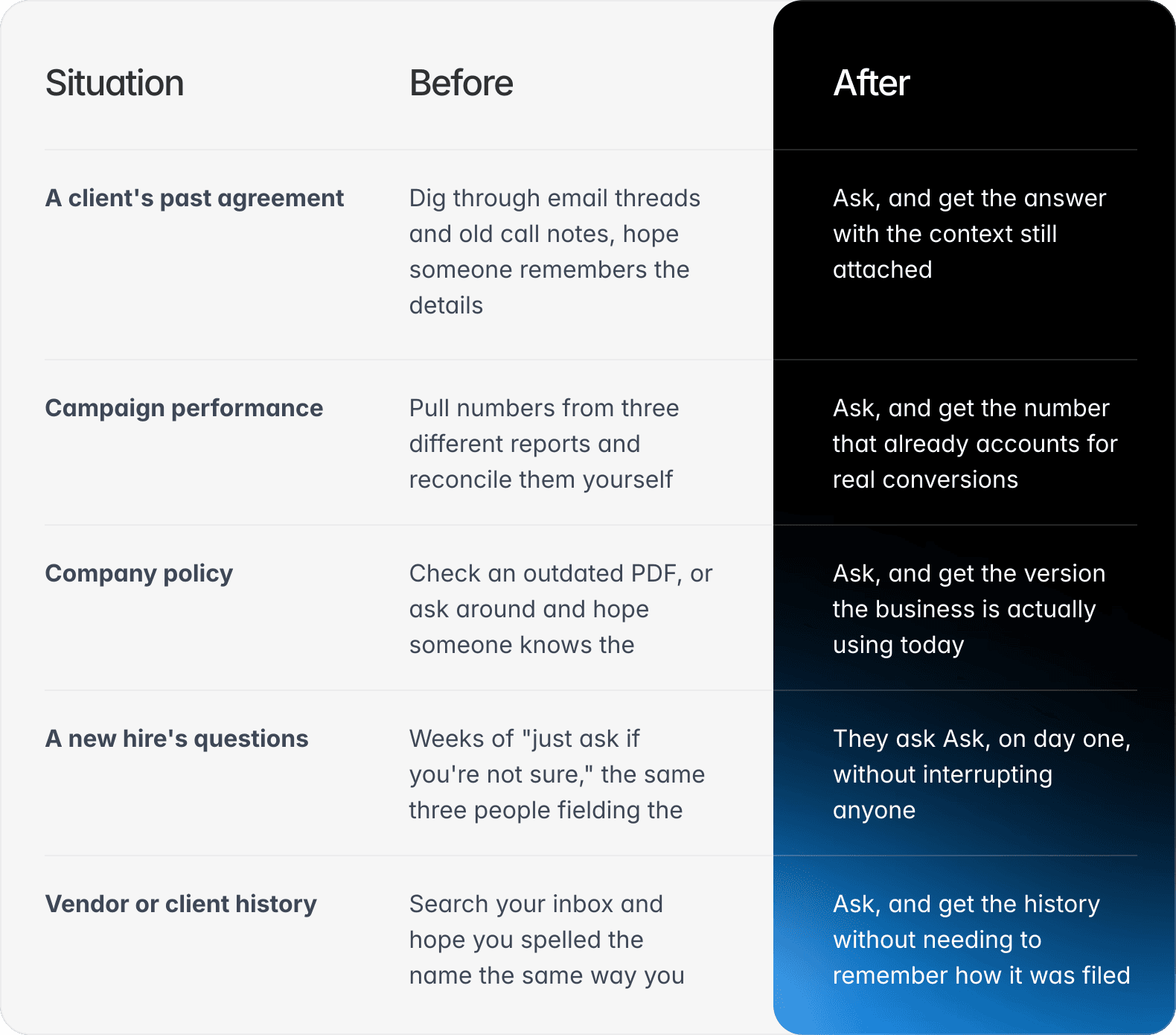
Before Ask. After Ask.
The shift is the same across almost any business question you can name: before, the answer exists somewhere and someone has to go find it. After, you ask and it's just there.
The one you talk to
Ask is different from a general AI assistant like ChatGPT or Gemini because it's wired into your business's own records, not just trained on the general internet. General-purpose AI tools are excellent at a lot of things. They can draft, brainstorm, summarize a document you hand them. What they can't do is know your business, because your business was never part of what they were trained on. Ask a general assistant what your client agreed to last month, and it has nothing to work with. It doesn't know the call happened. It's the same gap that shows up when an inbox-only tool tries to run your whole workday: it can only ever see the piece it was built to see.
Ask is built the other way. It's wired into the conversations, records, and context your business already has, so the answers it gives are actually about your business, not a generic best guess dressed up to sound confident.
That's the whole shift. Not a smarter search engine. Not another place to store information. The one you actually talk to, and the one that already knows what you're talking about.
And Ask doesn't start over every time. The more your business runs through Central, the calls Frontdesk answers, the emails your EA drafts, the meetings that get logged, the more Ask actually has to work with. Ask isn't a static database you have to feed and maintain. It grows the same way an employee's understanding of the business grows: by being there for what happened.
Start with the question you keep re-asking
The easiest way to find out if Ask is useful is to bring it the one question your team keeps re-asking. You don't need a rollout plan or a training session to find out if this is useful. You need one question you've asked more than once this month, the kind that always ends in someone digging through old messages to find an answer that already existed.
Ask it. See what comes back.
FAQS
Is Ask just a smarter search bar?
No. Search returns a list of places an answer might be hiding. Ask gives you the answer directly, in plain language, grounded in what your business has actually said and recorded.
Do I need to set anything up before Ask is useful?
No extensive setup required to start. Ask works with the context your business already has, so you're not starting from a blank slate or building a knowledge base from scratch before it's useful.
Is Ask a separate product I have to buy?
No. Ask is included with your plan. It isn't a separate product or an add-on you need to purchase on top of what you're already using.
Can my whole team use Ask, or just me?
Your whole team. Everyone gets the same access to the same business context, so the answer to a question doesn't depend on who happens to remember it.
Is my business data secure with Ask?
Yes. Your records, conversations, and calendar entries are encrypted and never shared with third parties.
Does Ask only work with email, or does it connect to other tools too?
It's wired into more than your inbox. Ask draws on your CRM, your team's Slack, and the other context your business already has, not just what's sitting in one inbox.